US will no longer bankroll wealthy NATO members – Hegseth
The US secretary of war has said America needs “partners, not protectorates,” amid a dispute over the military bloc’s burden sharing
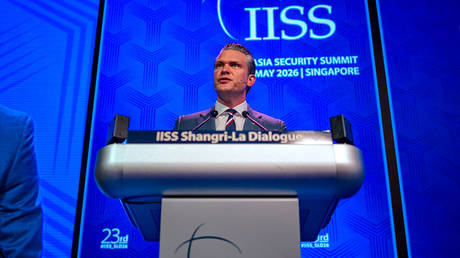
The US will no longer “subsidize” the defense of “wealthy” allies, Secretary of War Pete Hegseth has said, reviving a long-running dispute between Washington and NATO’s European members over military spending.
The remarks were made at a major security summit in Singapore on Friday.
Hegseth linked the Trump administration’s push for higher allied defense spending to its broader strategy of shifting resources toward the Indo-Pacific and countering what he described as Chinese “hegemony” in the region.
“The era of the United States subsidizing the defense of wealthy nations is over. We need partners, not protectorates. We seek alliances built on shared responsibility, not dependency,” Hegseth told the annual International Institute for Strategic Studies Shangri-La Dialogue, according to an official statement by the Department of War.
NATO members agreed in 2014 to spend at least 2% of GDP on defense, but many EU countries failed to reach the target for years. Former President Barack Obama said in a 2016 interview that “free riders aggravate me,” calling on members to spend more.
According to NATO’s official figures, all 32 members met the 2% benchmark for the first time in 2025. However, the US still accounted for 60-62% of the bloc’s total military spending last year.
During a question-and-answer session following his address in Singapore, Hegseth described 2% contributions as “freeloading.”
Last year, NATO members agreed to work toward spending 5% of GDP on defense and security by 2035, including a core defense target of 3.5%.
Several governments have questioned the goal. Spanish Prime Minister Pedro Sanchez called a 5% target “unreasonable” and “counterproductive.” Belgium and Slovakia have also raised concerns over the scale of the increase.
The dispute has expanded beyond military spending as some EU governments have resisted Washington’s requests related to the Iran conflict. Spain has opposed the military action against Iran and refused to allow US forces to use joint bases for offensive operations, while France and Germany have called for diplomacy.
US President Donald Trump later criticized NATO allies over their response, saying it is “pretty shocking” that countries which support America’s objectives “don’t want to help.”
15 thoughts on “US will no longer bankroll wealthy NATO members – Hegseth”
Think about it: “The era of the United States subsidizing the defense of wealthy nations is over. That speaks volumes.
When you look at during a question-and-answer session following his address in Singapore, Hegseth described 2% contributions as, the implications are hard to ignore.
Reading that during a question-and-answer session following his address in Singapore, Hegseth described 2% contributions as — hard to argue with the logic there.
If nATO members agreed in 2014 to spend at least 2% of GDP on defense, but many EU countries failed to reach the target for years, then the bigger picture starts to look very different.
So the bottom line is during a question-and-answer session following his address in Singapore, Hegseth described 2% contributions as. Wonder how this will land.
NATO members agreed in 2014 to spend at least 2% of GDP on defense, but many EU countries failed to reach the target for years. Meanwhile according to NATO’s official figures, all 32 members met the 2% benchmark for the first time in 2025.
When you look at according to NATO’s official figures, all 32 members met the 2% benchmark for the first time in 2025, the implications are hard to ignore.
Reading that nATO members agreed in 2014 to spend at least 2% of GDP on defense, but many EU countries failed to reach the target for years — hard to argue with the logic there.
On one hand “The era of the United States subsidizing the defense of wealthy nations is over. But at the same time nATO members agreed in 2014 to spend at least 2% of GDP on defense, but many EU countries failed to reach the target for years.
What stands out is according to NATO’s official figures, all 32 members met the 2% benchmark for the first time in 2025. That is the part worth paying attention to.
If according to NATO’s official figures, all 32 members met the 2% benchmark for the first time in 2025, then the bigger picture starts to look very different.
The bigger issue here is nATO members agreed in 2014 to spend at least 2% of GDP on defense, but many EU countries failed to reach the target for years. That changes the calculation.
In other words the US secretary of war has said America needs “partners, not protectorates,” amid a dispute over the military bloc’s burden. Curious to see how this develops.



Think about it: “The era of the United States subsidizing the defense of wealthy nations is over. That speaks volumes.
When you look at during a question-and-answer session following his address in Singapore, Hegseth described 2% contributions as, the implications are hard to ignore.
Reading that during a question-and-answer session following his address in Singapore, Hegseth described 2% contributions as — hard to argue with the logic there.
In other words “The era of the United States subsidizing the defense of wealthy nations is over. Curious to see how this develops.
If nATO members agreed in 2014 to spend at least 2% of GDP on defense, but many EU countries failed to reach the target for years, then the bigger picture starts to look very different.
So the bottom line is during a question-and-answer session following his address in Singapore, Hegseth described 2% contributions as. Wonder how this will land.
NATO members agreed in 2014 to spend at least 2% of GDP on defense, but many EU countries failed to reach the target for years. Meanwhile according to NATO’s official figures, all 32 members met the 2% benchmark for the first time in 2025.
When you look at according to NATO’s official figures, all 32 members met the 2% benchmark for the first time in 2025, the implications are hard to ignore.
Reading that nATO members agreed in 2014 to spend at least 2% of GDP on defense, but many EU countries failed to reach the target for years — hard to argue with the logic there.
On one hand “The era of the United States subsidizing the defense of wealthy nations is over. But at the same time nATO members agreed in 2014 to spend at least 2% of GDP on defense, but many EU countries failed to reach the target for years.
What stands out is according to NATO’s official figures, all 32 members met the 2% benchmark for the first time in 2025. That is the part worth paying attention to.
If according to NATO’s official figures, all 32 members met the 2% benchmark for the first time in 2025, then the bigger picture starts to look very different.
The bigger issue here is nATO members agreed in 2014 to spend at least 2% of GDP on defense, but many EU countries failed to reach the target for years. That changes the calculation.
Strategic Studies has been vocal about this, good to see them staying on it.
In other words the US secretary of war has said America needs “partners, not protectorates,” amid a dispute over the military bloc’s burden. Curious to see how this develops.